
Blog — Compliance · 9 min read
ATEX compliance for
combustible powders
Why milk powder and flour form explosive atmospheres, and what zone classification requires.
In short
Most food powders — milk powder, flour, sugar, starch — are combustible dusts: dispersed as a cloud, they can ignite and explode. ATEX (EU) and IECEx (international) frameworks manage the risk through hazardous-area zoning (dust zones 20, 21, 22), certified equipment categories, ignition-source control and engineered explosion protection.
The post
Why ordinary ingredients explode
Fine particle size turns fuel into hazard. Below roughly half a millimetre, an organic powder's surface area is so high that a dispersed cloud propagates flame in milliseconds. The infamous cases — flour mills, sugar refineries, milk powder dryers — are all ordinary food materials at processing fineness.
An explosion needs five elements, the dust explosion pentagon: fuel, oxygen, ignition, dispersion and confinement. Powder plants create the first four at every transfer point; the fifth is any vessel or room. Safety engineering removes at least one element, systematically.
The post
Zones 20, 21, 22
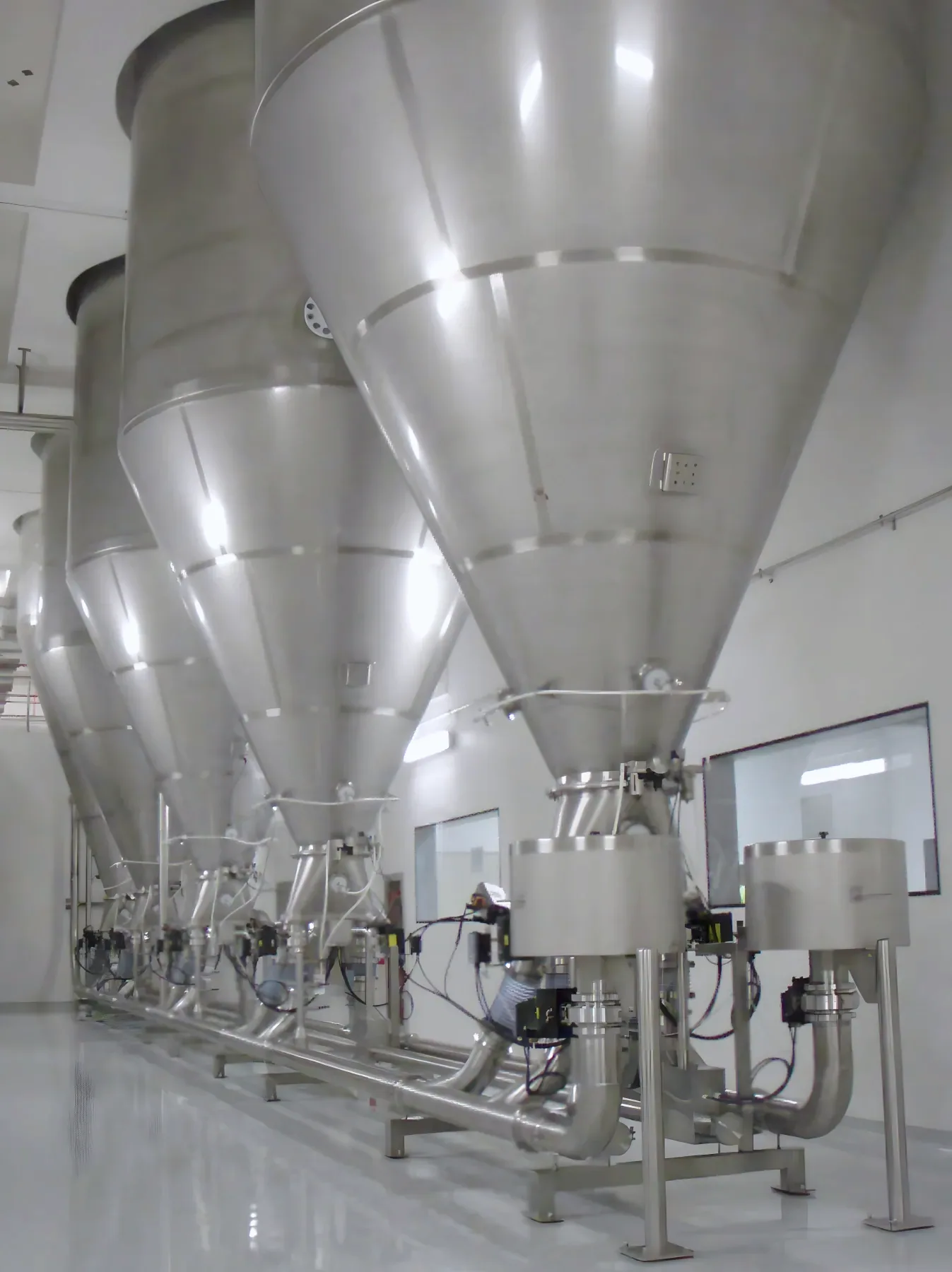
Dust hazardous areas are classified by how often an explosive cloud is present. Zone 20: continuously or for long periods — the inside of silos, hoppers and convey lines. Zone 21: likely in normal operation — around bag tip stations and filling heads. Zone 22: unlikely and brief — general plant areas that see dust only in upset conditions.
The zone dictates the equipment: category 1D for zone 20, 2D for 21, 3D for 22, each with temperature limits set by the powder's ignition properties.
The post
ATEX and IECEx, briefly
ATEX is EU law: Directive 2014/34/EU for equipment, 1999/92/EC for workplaces. IECEx is the IEC's international certification scheme built on the same IEC 60079 standards — and the native regime for New Zealand and Australia via the AS/NZS 60079 series. Most quality equipment carries both markings; exporters specify them for international acceptance.
The post
What compliance looks like in practice
For a powder plant, the engineering deliverables are:
- A dust hazardous-area classification drawing for the site
- Equipment selected and documented to matching categories
- Ignition control: earthing, bonding, temperature-limited surfaces
- Explosion protection on vessels: venting, suppression or containment
- Isolation (e.g. certified rotary valves) so an event cannot propagate
- Housekeeping design: extraction at source, no dust-layer accumulation
Common questions
Frequently asked questions.
- Is milk powder a combustible dust?
- Yes. Milk powder is a classified St 1 combustible dust — a dispersed cloud can ignite and explode, and dryer fires are a known industry hazard. Milk powder plants are dust-zoned and equipped accordingly.
- What is the difference between ATEX and IECEx?
- ATEX is EU legislation, mandatory for the EU market. IECEx is the international certification scheme based on the same IEC standards, and the usual compliance route in New Zealand and Australia. Equipment commonly carries both.
- What are dust zones 20, 21 and 22?
- A likelihood scale for explosive dust clouds: zone 20 — present continuously (inside vessels and lines); zone 21 — likely in normal operation (around open transfer points); zone 22 — unlikely and short-lived. Equipment categories 1D, 2D and 3D map to them.
Related
Related pages.
Discuss your project.
Talk to an engineer.
Send the material, throughput and plant constraints. You’ll get a considered answer from an engineer, not a brochure.