
Solutions — dust & fume control
Industrial dust extraction
for powder plants.
Every transfer point breathes dust. Extraction designed with the line captures it at the source — for hygiene, for compliance, and because escaped powder is escaped product.
In brief
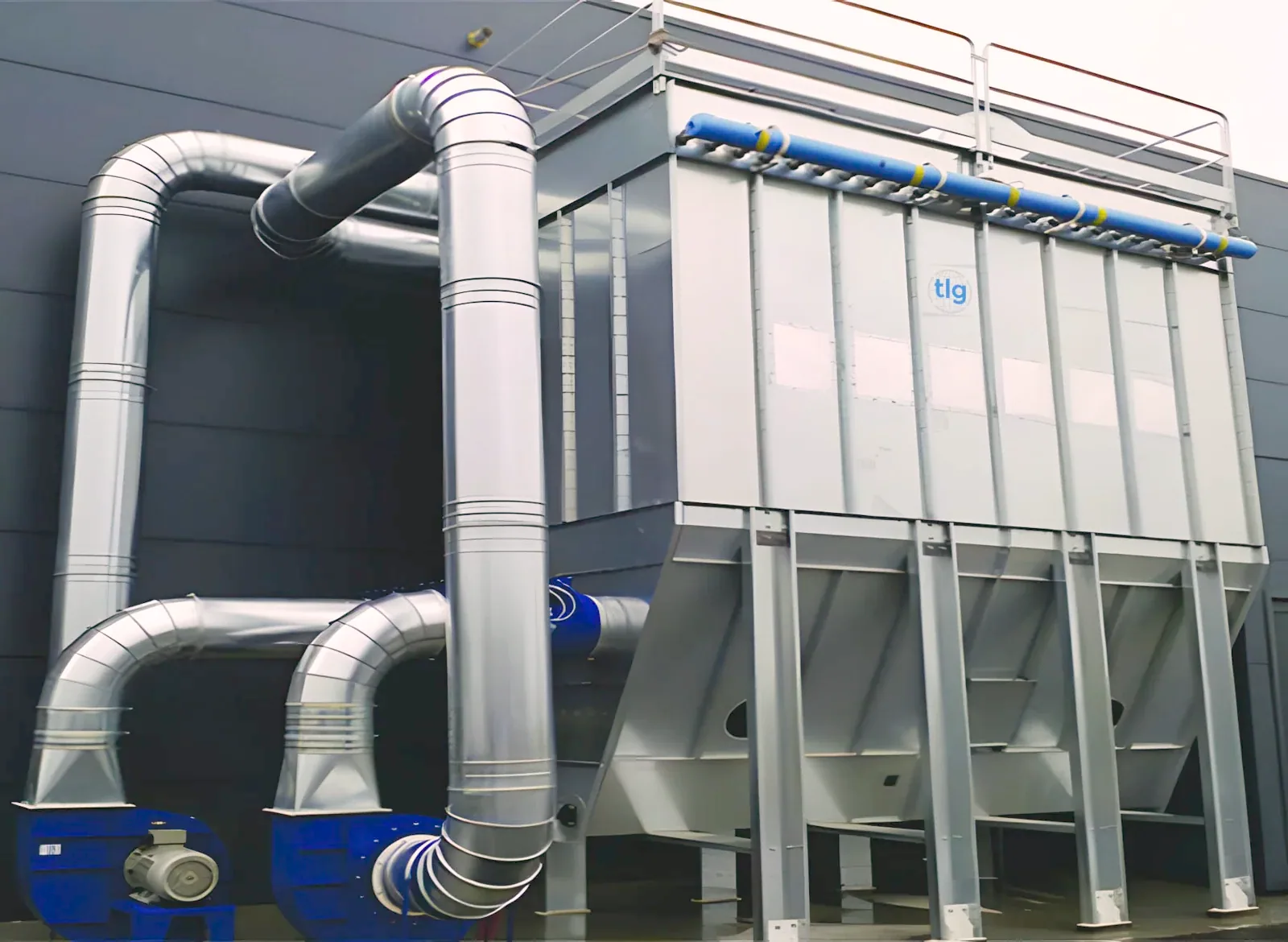
Industrial dust extraction captures airborne powder at its sources — tip points, transfer points, filling heads — through ducted pickups into reverse-jet filter units. TLG designs extraction as part of the powder line, sizing capture velocities at each point and handling collected product back into the process where hygiene allows.
In detail
How it works.
The design work is at the pickup, not the filter: each capture point needs enough face velocity to catch its plume without robbing the others. TLG balances the duct network, sizes the reverse-jet unit for the total, and — in food plants — closes the loop by returning collected product to the process where standards permit.
In combustible-powder plants the extraction system is itself ATEX territory: vented or suppressed filter units, isolation between the collector and the plant. The unit photographed is a TLG installation.
- Also known as
- Dust collectors
- Capture
- Ducted pickups at tip, transfer and filling points
- Filtration
- Reverse-jet cleaned cartridge and bag units
- Compliance
- ATEX venting/suppression and isolation where zoned
- Recovery
- Collected-product return where hygiene allows
Common questions
Frequently asked questions.
- What are the types of dust collectors?
- The main families are reverse-jet cartridge collectors, bag filters (baghouses) and cyclone separators. Cartridges suit fine dusts and compact spaces; baghouses take high volumes; cyclones act as pre-separators for coarse material ahead of finer filtration.
Related
Related pages.
Discuss your project.
Talk to an engineer.
Send the material, throughput and plant constraints. You’ll get a considered answer from an engineer, not a brochure.