
Blog — Storage · 7 min read
Types of silos
for powder storage
Tower, bunker and bag silos — and why discharge geometry matters more than any of them.
In short
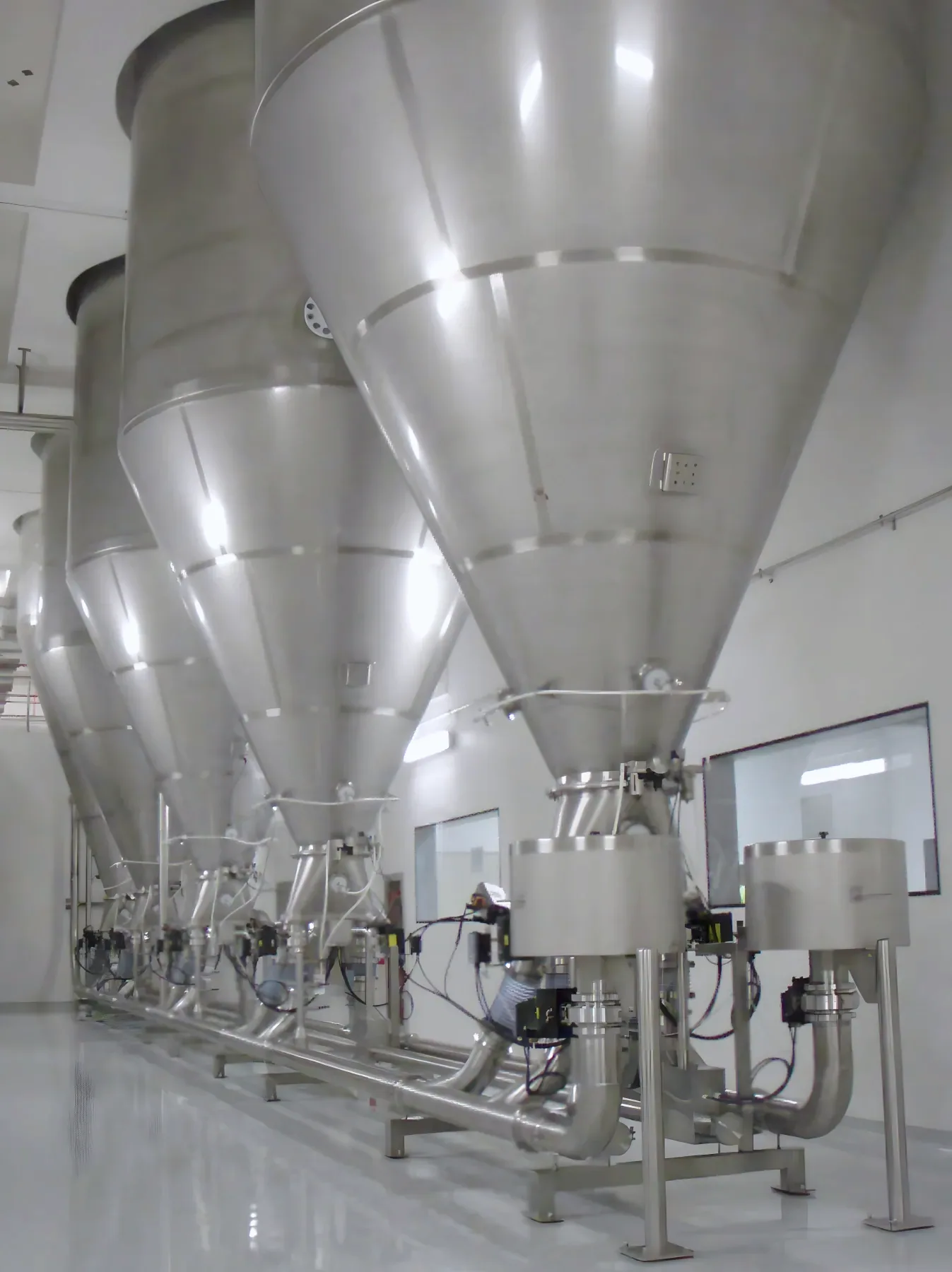
Silos are conventionally grouped into three types: tower silos (vertical cylinders — the standard for powders), bunker silos (horizontal, mainly agricultural) and bag silos (temporary polyethylene storage). In powder processing, the type is the least important decision — what matters is material (stainless for food duty), discharge geometry (mass flow vs funnel flow) and hygiene design.
The post
The three conventional types
Tower silos are vertical cylinders with a conical or flat bottom — every industrial powder silo is some variation of this form. Bunker silos are horizontal trenches, filled and emptied by loader, and belong to silage and aggregate, not processed powder. Bag silos are long polyethylene tubes used as temporary farm storage.
For food, dairy and beverage processing, only the tower form is relevant — which is why the useful engineering questions are all about what kind of tower.
The post
Silo storage vs warehouse storage
The real decision many processors face is not which silo, but silo versus bagged stock in a warehouse. Bulk silo storage wins on ingredient cost (bulk tanker prices beat bagged prices), labour (no bag slitting, lifting or disposal), hygiene (a closed system versus an opened bag), and dust (contained transfer versus tipping). Bagged warehouse stock wins on flexibility — many ingredients in small volumes, no capital commitment.
The crossover is throughput: once a single ingredient moves faster than roughly a tanker-load every few weeks, silo storage usually pays for itself in ingredient price difference alone.
The post
Mass flow or funnel flow — the decision that matters
Two silos of identical size can behave completely differently at the outlet. In mass flow, the whole contents move down together — first in, first out, no dead zones, predictable discharge. In funnel flow, a channel empties through the centre while material at the walls sits static — inviting bridging, rat-holing, and stale product against the wall.
Mass flow is bought with geometry: a steep enough cone, a smooth enough wall, a large enough outlet — all calculated from the powder's measured flow properties. This calculation, not the silo type, is where storage projects succeed or fail.
The post
Food-duty specifics
A powder silo for food processing adds:
- Stainless construction with hygienic internal finish
- Dust-controlled filling — convey line in, displaced air out through a top filter
- Level and inventory instrumentation (load cells where stock accuracy matters)
- Moisture management for hygroscopic powders
- CIP provision where the product demands wet cleaning
Common questions
Frequently asked questions.
- What are the three types of silos?
- Tower silos (vertical cylinders — the industrial standard), bunker silos (horizontal, filled by loader, mainly agricultural) and bag silos (temporary polyethylene tubes). Powder processing uses the tower form almost exclusively; the meaningful choices are material, discharge geometry and hygiene design.
- What is the difference between mass flow and funnel flow?
- In mass flow the entire contents move down together — first in, first out, reliable discharge. In funnel flow a central channel empties while wall material sits static, which invites bridging and stale product. Mass flow is achieved by engineering the cone angle, wall finish and outlet size to the powder's measured properties.
Related
Related pages.
Discuss your project.
Talk to an engineer.
Send the material, throughput and plant constraints. You’ll get a considered answer from an engineer, not a brochure.