
Mechanical — flexible screw
Flexible screw
conveyors.
A spiral turning inside a tube — no bearings at the product end, one moving part, and a price that makes it the first option checked.
In brief
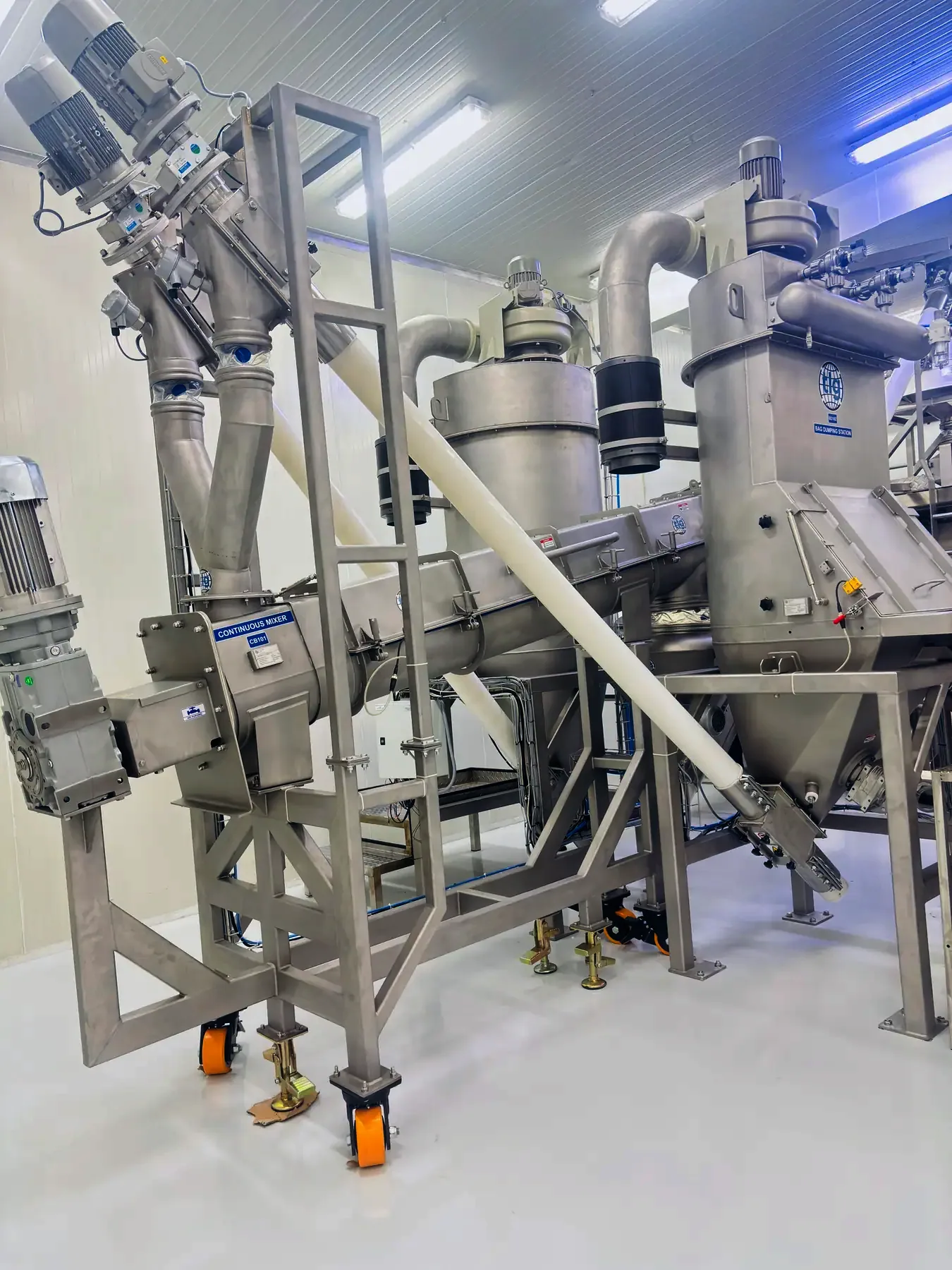
A flexible screw conveyor moves powder with a rotating spiral inside a polymer or stainless tube, driven from the discharge end. With one moving part and no bearings or seals in the product zone, it is the simplest and most economical mechanical conveyor for short inclined runs from bag dump stations and hoppers.
In detail
How it works.
The spiral centres itself in the tube as it turns, gently rolling product forward — effective for powders, granules and blends that must not separate. Runs of a few metres at moderate rates are its home ground; routes needing bends, long distances or high rates move to pneumatic.
Strip-down is deliberate minutes, not hours: the spiral withdraws from the tube for cleaning, which is why flexible screws are everywhere in food plants with allergen changeovers.
- Geometry
- Straight or gently curved runs, typically to ~10 m
- Product zone
- No bearings or seals — spiral and tube only
- Hygiene
- Food-grade tube materials; fast strip-down for changeover
- Feed points
- Bag dump stations, hoppers, bulk bag unloaders
Common questions
Frequently asked questions.
- What is the difference between a flexible screw and a rigid screw conveyor?
- A rigid screw turns inside a fixed trough or tube on end bearings, suits horizontal high-rate duties and dosing, and holds tighter transfer accuracy. A flexible screw's spiral floats in its tube, tolerates gentle curves and inclines, and strips down faster — the simpler machine, and the default for short, simple transfers.
Related
Related pages.
Discuss your project.
Talk to an engineer.
Send the material, throughput and plant constraints. You’ll get a considered answer from an engineer, not a brochure.