
Mechanical — rigid screw
Screw conveyors
and auger systems.
The auger has moved bulk material for two thousand years because it works: contained, predictable, and controllable down to dosing accuracy.
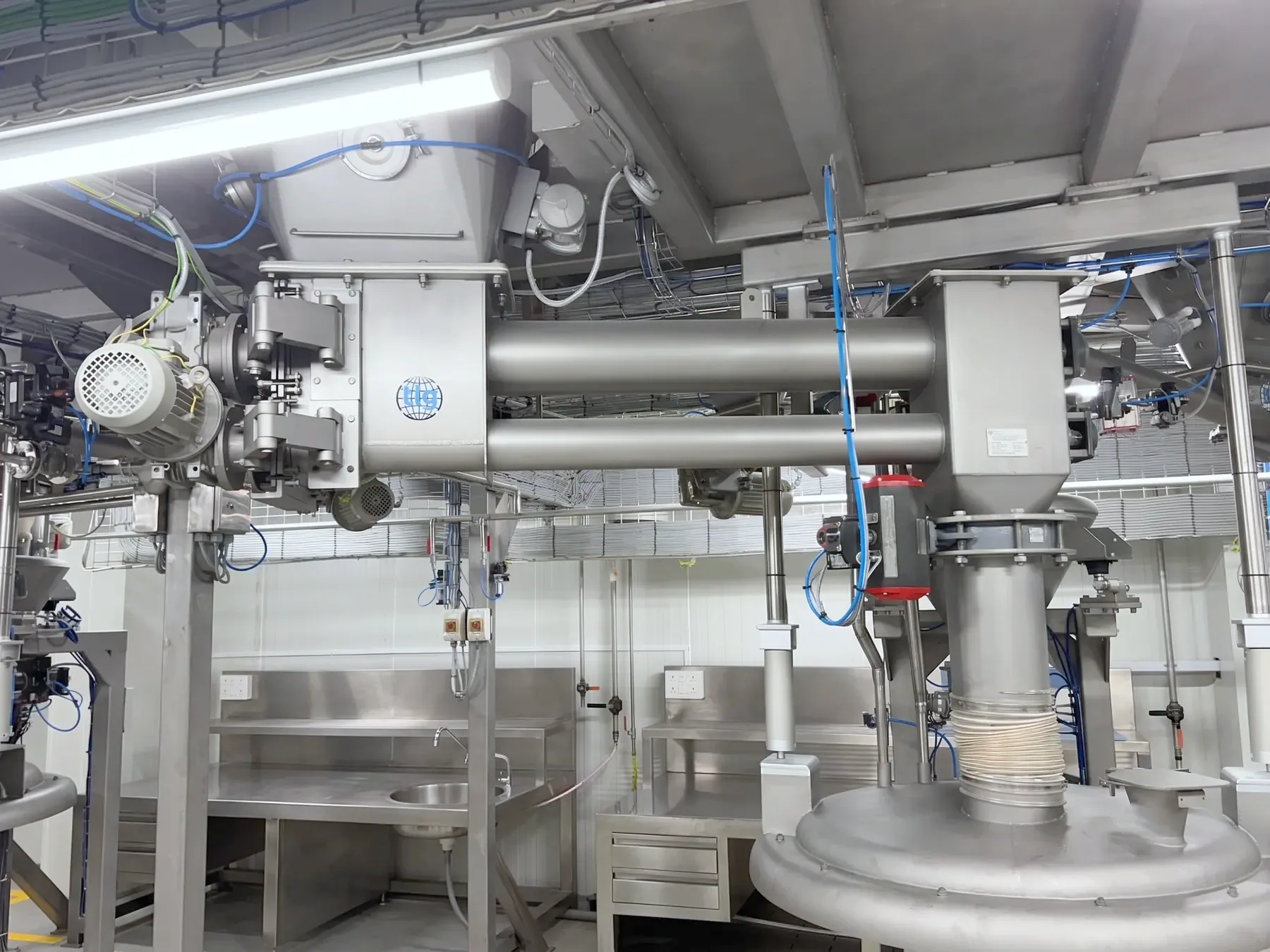
In brief
A rigid screw conveyor (auger conveyor) transfers powder with a helical flight rotating in a fixed U-trough or tube. It gives contained, highly controllable transfer over horizontal and inclined runs, and — geared and metered — doubles as a dosing feeder. TLG fabricates stainless food-grade screws sized to the duty.
In detail
How it works.
Speed is rate: a screw's throughput follows its RPM almost linearly, which makes it the natural metering device ahead of mixers, packing heads and reactors. Variants — shaftless for sticky products, ribbon flights for blending in transit, cooled jackets for hot powders — extend the same principle.
TLG's screws are fabricated in-house in stainless, with quick-release covers and CIP options where wash-down hygiene is specified.
- Also known as
- Auger conveyor · screw auger conveyor
- Formats
- U-trough, tubular, shaftless; horizontal to steep incline
- Control
- VSD-driven metering to dosing accuracy
- Hygiene
- Stainless fabrication, quick-release covers, CIP options
Common questions
Frequently asked questions.
- What is the difference between a screw conveyor and a screw feeder?
- A conveyor moves material that is fed to it at a controlled rate; a feeder sets that rate itself, metering from a flood-loaded hopper. Mechanically similar, they are sized differently — a feeder's inlet runs full by design, so flight geometry and drive are selected for controlled extraction rather than simple transport.
Related
Related pages.
Discuss your project.
Talk to an engineer.
Send the material, throughput and plant constraints. You’ll get a considered answer from an engineer, not a brochure.